Menu

Commercial Rooftop Unit Installation in Washington, D.C. | Minimize Downtime and Maintain Business Operations

Peak HVAC Tampa delivers precise commercial RTU installation for Washington, D.C. businesses. Our crews work off-hours to prevent customer disruption and ensure your HVAC system meets federal building codes and local compliance requirements.

Slider Image 1
Slider Image 2
Slider Image 3
Slider Image 4
Slider Image 5
Slider Image 7
Slider Image 8
Slider Image 9
Slider Image 10
Slider Image 11

Why Washington, D.C. Commercial Buildings Require Specialized Rooftop Unit Installation

Commercial properties in Washington, D.C. face unique challenges for rooftop HVAC systems. The Mid-Atlantic climate delivers extreme temperature swings, with summer humidity above 70% and winter temperatures dropping below freezing. Your existing RTU absorbs condensation and thermal stress daily. Add in the salt air from the Potomac River and Chesapeake Bay, and metal components corrode faster than in inland cities.

Federal buildings and commercial properties near Capitol Hill must comply with strict energy efficiency standards under the District's Clean Energy DC Act. You cannot simply swap an old unit for a new one. Commercial rooftop HVAC installation requires load calculations, refrigerant line reconfiguration, and curb adapter modifications to meet Title 24 energy codes. Many buildings in Georgetown and Dupont Circle are historic structures. You face additional hurdles with rooftop access, crane positioning, and structural load limits on older masonry buildings.

A failing RTU costs you revenue. When your rooftop package unit fails during peak season, you lose customer comfort, employee productivity, and product integrity. Restaurants lose perishable inventory. Medical offices reschedule patients. Retail stores watch foot traffic disappear. Your business continuity depends on a commercial RTU install that accounts for your building's specific load requirements, electrical service capacity, and rooftop structural integrity. Off-the-shelf units fail when installers ignore these variables. You need a team that understands Washington, D.C.'s commercial building stock and regulatory environment.

Why Washington, D.C. Commercial Buildings Require Specialized Rooftop Unit Installation
How We Execute Commercial RTU Installation Without Disrupting Your Operations

How We Execute Commercial RTU Installation Without Disrupting Your Operations

Our commercial rooftop HVAC installation process begins with a structural assessment and load calculation. We measure your building's cooling load in BTUs per square foot, factoring in window area, occupancy density, and equipment heat gain. This determines the tonnage you actually need, not what the previous installer guessed. We verify your rooftop's weight capacity with the building engineer. Older buildings in Washington, D.C.'s central business district have weight restrictions. We calculate the combined load of the new RTU, curb adapter, and service clearances before committing to a specific unit.

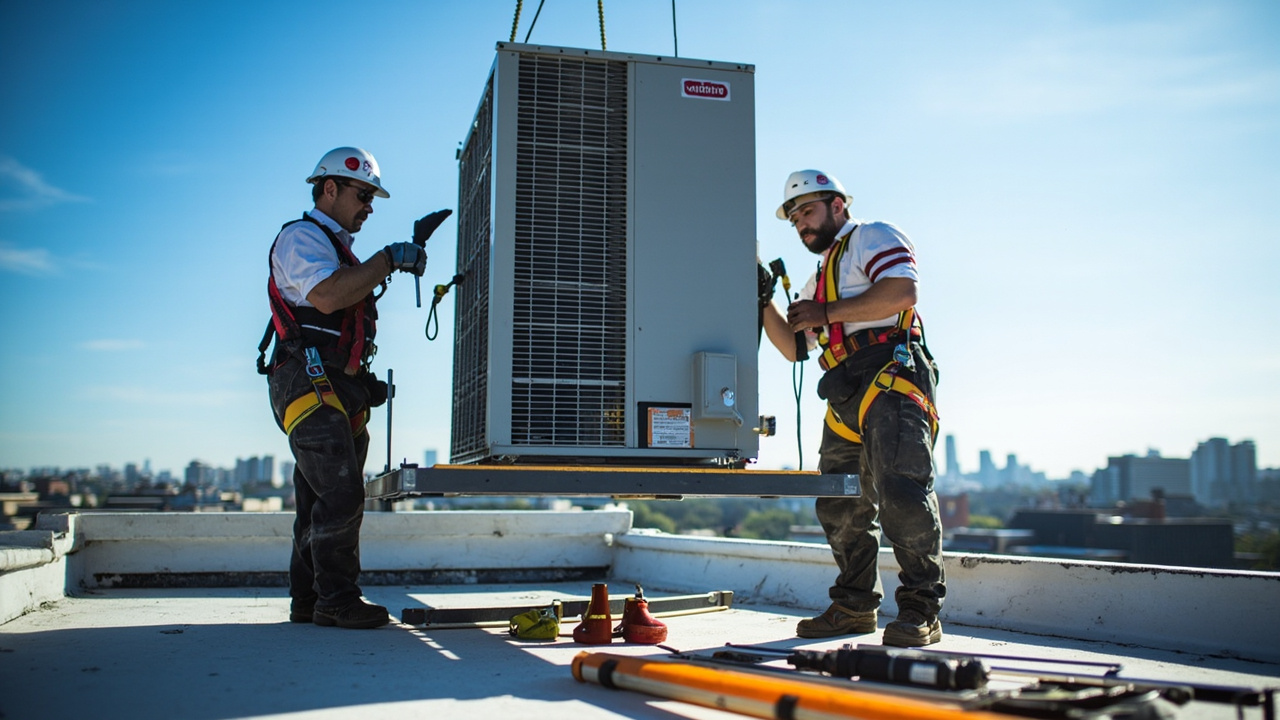
We schedule crane lifts and rigging during off-peak hours. For retail and restaurant clients, we work overnight or on Sundays. The old unit comes off the roof, and the new rooftop package unit goes up in a single shift. Our crews pre-fabricate ductwork transitions and electrical connections off-site. When we arrive, the mechanical rough-in happens fast. We minimize the window when your building has no cooling or heating.

Refrigerant line sets require precise brazing and nitrogen purging. We pressure-test all connections to 500 PSI and verify zero leaks before charging the system. Electrical connections must match the unit's voltage and phase requirements. Single-phase power on a three-phase RTU causes compressor failure within weeks. We verify voltage at the disconnect and confirm amp draw matches the nameplate specifications. Our commercial RTU install includes commissioning with airflow measurement at each supply register. We document the results and hand you a performance report that proves your system meets design specifications.

What Happens During Your Commercial Rooftop Unit Replacement

Commercial Rooftop Unit Installation in Washington, D.C. | Minimize Downtime and Maintain Business Operations
01

Site Assessment and Engineering

We inspect your existing RTU and measure rooftop access points, structural load capacity, and electrical service. Our team reviews building plans and confirms compliance with District of Columbia mechanical codes. You receive a detailed scope of work with equipment specifications, crane logistics, and a timeline that avoids peak business hours. We coordinate with your property manager to secure permits and schedule utility shutdowns.
02

Unit Removal and Installation

Our rigging crew arrives with a crane sized for your building height and unit weight. We disconnect refrigerant lines, electrical feeds, and ductwork transitions. The old rooftop package unit lifts off, and the new RTU sets onto the curb adapter within the same shift. We reconnect all mechanical and electrical systems, pressure-test refrigerant lines, and verify proper amperage draw. Your building remains operational with minimal disruption to tenants or customers.
03

System Commissioning and Documentation

We start the new RTU and measure supply air temperature, static pressure, and amperage across all phases. Our technicians adjust airflow dampers and verify thermostat communication. You receive commissioning reports, warranty documentation, and an equipment maintenance schedule. We walk your facilities team through the new unit's controls and filter replacement procedures. Your system is fully operational and documented for future service needs.

Why Washington, D.C. Commercial Property Managers Trust Our RTU Installation Team

Commercial rooftop AC replacement in Washington, D.C. requires familiarity with local building codes and federal energy standards. The District enforces strict refrigerant handling protocols under EPA Section 608 regulations. Our technicians hold universal refrigerant certifications and follow recovery procedures that prevent costly fines. We document all refrigerant transactions and provide you with disposal certificates for your compliance files.

Buildings near federal properties face additional security clearances and access restrictions. We coordinate with building security teams and obtain necessary badges before arrival. Our crews understand the protocols for working near government facilities and respect your tenant privacy requirements. We have completed RTU installations for office buildings along K Street, medical centers near Washington Circle, and hospitality properties in Navy Yard.

Washington, D.C.'s building stock includes everything from 1920s masonry structures to modern glass towers. Each building type requires different installation techniques. Historic buildings have limited rooftop access and weight restrictions. Modern buildings have Building Management Systems that require integration with the new RTU's controls. We adapt our approach based on your building's specific conditions. Our project managers communicate with your engineering staff and provide progress updates throughout the installation. You know exactly when the crane arrives, when the power shuts off, and when your system comes back online. No surprises. No extended downtime. Just a functioning rooftop unit that keeps your business running.

What You Get With Our Commercial Rooftop Unit Installation Service

Fast Turnaround With Minimal Business Disruption

Most commercial RTU installations complete within 24 to 48 hours from crane arrival to final commissioning. We schedule the work around your business operations. Retail clients get weekend installations. Restaurants get overnight service. Office buildings get evening and early morning access. Our crews arrive with pre-fabricated components and complete mechanical connections in a single shift. You avoid extended shutdowns that cost you revenue. Emergency replacements for failed units happen within 72 hours if we have the equipment in stock. We maintain relationships with major manufacturers to expedite delivery on critical replacements.

Comprehensive Load Calculations and Equipment Sizing

We perform Manual J load calculations to determine your building's actual cooling and heating requirements. This prevents oversized units that short-cycle and waste energy. It also prevents undersized units that run continuously and fail early. Our calculations factor in your building's orientation, window area, insulation values, and internal heat loads from equipment and occupants. You get an RTU sized precisely for your building's thermal characteristics. We review your utility bills and compare energy consumption before and after installation. Proper sizing typically reduces energy costs by 15% to 25% compared to incorrectly sized units.

Code-Compliant Installation With Full Documentation

Your new rooftop package unit meets all District of Columbia mechanical codes and federal energy standards. We pull permits through the Department of Consumer and Regulatory Affairs and schedule inspections. You receive copies of all permit approvals, inspection reports, and commissioning documentation. This paperwork protects you during lease audits, building sales, and insurance claims. We provide equipment cut sheets, warranty registrations, and maintenance schedules. Your facilities team has everything needed for future service and compliance verification. Building inspectors recognize our work and rarely request corrections.

Ongoing Maintenance Plans and Priority Service

We offer preventive maintenance agreements that include quarterly inspections, filter changes, and refrigerant level checks. Regular maintenance extends equipment life and prevents unexpected failures during peak season. Maintenance clients receive priority scheduling for repairs and replacements. When your RTU fails on a 95-degree day, you move to the front of the queue. Our maintenance plans include detailed service logs that document your equipment's performance history. This documentation helps with warranty claims and provides proof of proper maintenance if you sell the building. You avoid the stress of finding a contractor when something breaks.

Frequently Asked Questions

You Have Questions,
We Have Answers

How much does it cost to install a rooftop unit? +

Rooftop unit installation costs for commercial buildings in Washington, D.C. vary based on tonnage, refrigerant type, electrical requirements, and crane access. A 5-ton RTU typically costs less than a 20-ton unit serving a retail space. D.C. building code mandates specific energy efficiency standards, which influence equipment selection. Structural assessments are required to verify the roof can support the load, especially on older buildings near Capitol Hill or Shaw. Electrical upgrades to meet current code add cost. Gas line connections, curb adapters, and ductwork modifications factor into the total investment. Request a site evaluation to determine your building's specific requirements and obtain accurate pricing.

What is the $5000 rule for AC? +

The $5,000 rule is a residential guideline used to determine repair versus replacement decisions. You multiply the system age by the repair cost. If the result exceeds $5,000, replacement makes better financial sense. For commercial rooftop units in Washington, D.C., this rule does not apply. Commercial HVAC decisions focus on lifecycle cost analysis, business interruption risk, and operational efficiency. D.C. businesses must weigh equipment downtime against revenue loss. A failing RTU during summer humidity can disrupt operations in restaurants or retail spaces. Commercial decisions require ROI calculations, not simple residential formulas. Consult with a commercial HVAC professional to analyze your specific situation.

What is the 2 foot rule for HVAC? +

The 2-foot rule refers to clearance requirements around HVAC equipment for service access and code compliance. Washington, D.C. building codes mandate minimum clearances for rooftop units to allow technicians safe access to panels, filters, and components. This rule prevents obstructions from blocking maintenance work or restricting airflow to condenser coils. On flat commercial roofs common throughout D.C., you must maintain clearances from parapets, vents, and other rooftop equipment. Proper spacing prevents efficiency loss and reduces service costs. Violating clearance requirements can result in code violations during inspections. Plan RTU placement carefully during installation to ensure compliance and long-term serviceability.

What are the disadvantages of RTU? +

Rooftop units present specific challenges for commercial buildings in Washington, D.C. Exposure to weather accelerates wear on components, especially during humid summers and freeze-thaw winter cycles. Roof membrane damage can occur during installation or maintenance if contractors do not protect waterproofing properly. RTUs require structural support verification, which older D.C. buildings near Dupont Circle may lack without reinforcement. Noise transmission through the roof deck can disrupt office environments if vibration isolation is inadequate. Crane access in dense urban areas adds logistical complexity and cost. Energy efficiency can suffer if ductwork runs are poorly designed. Despite these drawbacks, RTUs remain cost-effective for many commercial applications when installed correctly.

How much is HVAC for a 2000 square-foot house? +

This question addresses residential HVAC, not commercial rooftop unit installation. A 2,000-square-foot house typically requires a 3 to 4-ton split system, not an RTU. Residential systems in D.C. rowhouses or single-family homes use ground-level condensers with indoor air handlers. Commercial rooftop units serve different applications like retail stores, office buildings, and restaurants in Washington, D.C. Commercial installations involve different load calculations, building codes, and equipment specifications. If you operate a commercial property requiring climate control, focus on commercial-grade RTUs sized for your building's specific needs. Contact a commercial HVAC contractor to discuss your business facility requirements rather than residential comparisons.

What are the disadvantages of rooftop units? +

Rooftop units face distinct operational challenges in commercial settings throughout Washington, D.C. Weather exposure degrades components faster than indoor equipment, requiring more frequent maintenance. High humidity and temperature swings stress compressors and controls. Roof access for service requires coordination and safety equipment, increasing labor costs. Structural loading must be verified on older buildings, particularly in historic districts where roof framing may not support modern RTU weights. Urban environments around K Street generate airborne contaminants that clog filters and coils quickly. Vandalism or storm damage poses risks on accessible roofs. However, RTUs remain practical for commercial applications because they conserve interior space and simplify installation in multi-tenant buildings.

How Washington, D.C.'s Federal Building Standards Impact Commercial RTU Installation

Washington, D.C. enforces some of the strictest energy efficiency standards in the country. The Clean Energy DC Act requires commercial buildings to meet aggressive carbon reduction targets. Your new RTU must achieve minimum SEER and EER ratings higher than federal minimums. Buildings over 50,000 square feet must comply with building performance standards that track energy use intensity. A poorly installed rooftop unit that wastes energy puts you out of compliance and triggers fines. The District also requires refrigerant tracking and reporting under local environmental regulations. Every pound of refrigerant must be documented during installation, service, and disposal.

Commercial property owners in Washington, D.C. face unique liability concerns. Your HVAC system must maintain indoor air quality standards for tenant health and safety. A failed RTU during summer heat waves creates liability exposure if tenants suffer heat-related illness. Buildings near federal properties undergo additional scrutiny during inspections and audits. You need an installation team that understands these local requirements and delivers documentation that satisfies inspectors. Our crews work regularly with District building officials and know exactly what they expect to see during mechanical inspections. You avoid delays and reinspection fees.
HVAC Services in The Washington DC Area

Easily locate Patriot HVAC and explore our service area on the map below. We are strategically positioned to provide prompt and efficient heating, ventilation, and air conditioning services across Washington D.C. and its neighboring communities. Whether you're seeking a quick repair or a new installation, our team is ready to serve your comfort needs.

Address:
Patriot HVAC Washington DC, 20 F St NW, Washington, DC, 20001

Additional Services We Offer

Our news updates

Latest Articles & News from The Blogs

Meeting Friendship Heights Noise Rules with the Quietest New AC Units on the Market Friendship Heights homeowners know the struggle.…

Meeting Friendship Heights Noise Rules with the Quietest New AC Units on the Market

Meeting Friendship Heights Noise Rules with the Quietest New AC Units on the Market Friendship Heights homeowners know the struggle.…

Finding the right HVAC contractor for your LeDroit Park historic renovation

Finding the right HVAC contractor for your LeDroit Park historic renovation \n\n LeDroit Park’s Victorian rowhouses built in the 1870s…

How a Whole-House Dehumidifier Can Make Your Marshall Heights Home Feel 10 Degrees Cooler

How a Whole-House Dehumidifier Can Make Your Marshall Heights Home Feel 10 Degrees Cooler Washington DC's swampy summers make your…

Contact Us

Your business cannot afford extended downtime from a failed rooftop unit. Call (771) 218-6322 now to schedule a site assessment. We provide detailed quotes with equipment specifications and installation timelines. Our crews are ready to work around your schedule.