Menu

Emergency Ductwork Repair in Washington, D.C. – 24/7 Dispatch and Same-Day Arrival

Ductwork failures don't wait for business hours. Patriot HVAC Washington DC responds immediately with certified technicians who diagnose and repair critical duct damage fast, restoring airflow and preventing system collapse before your home or business suffers further loss.

Slider Image 1
Slider Image 2
Slider Image 3
Slider Image 4
Slider Image 5
Slider Image 7
Slider Image 8
Slider Image 9
Slider Image 10
Slider Image 11

Why Ductwork Fails Without Warning in D.C.'s Climate

You wake up to weak airflow. You hear rattling in the walls. Your energy bill doubled overnight. Ductwork failure is not gradual in Washington, D.C. The city's extreme seasonal swings push your system hard. Summer humidity creates condensation inside ducts, which corrodes sheet metal and softens mastic sealant. Winter freeze-thaw cycles cause flex duct to crack and rigid duct joints to separate. Attic temperatures in D.C. routinely exceed 130 degrees in July, which accelerates deterioration of insulation jackets and duct tape adhesives.

When a section collapses or detaches, conditioned air pours into your attic or crawlspace instead of reaching your rooms. Your blower motor compensates by working harder, which increases amperage draw and risks compressor failure. You are losing money and comfort every hour the damage persists. Immediate ductwork service is not optional when you smell burning insulation or hear metal banging inside your walls.

Patriot HVAC Washington DC runs 24/7 hvac duct repair operations because duct emergencies do not follow a schedule. We dispatch same day air duct fixing crews to homes in Georgetown, Capitol Hill, and Anacostia within 90 minutes of your call. Urgent air duct repair means stopping the leak, stabilizing the system, and preventing secondary damage to your HVAC equipment before compressor lockout occurs.

Why Ductwork Fails Without Warning in D.C.'s Climate
How We Stabilize and Repair Critical Duct Damage

How We Stabilize and Repair Critical Duct Damage

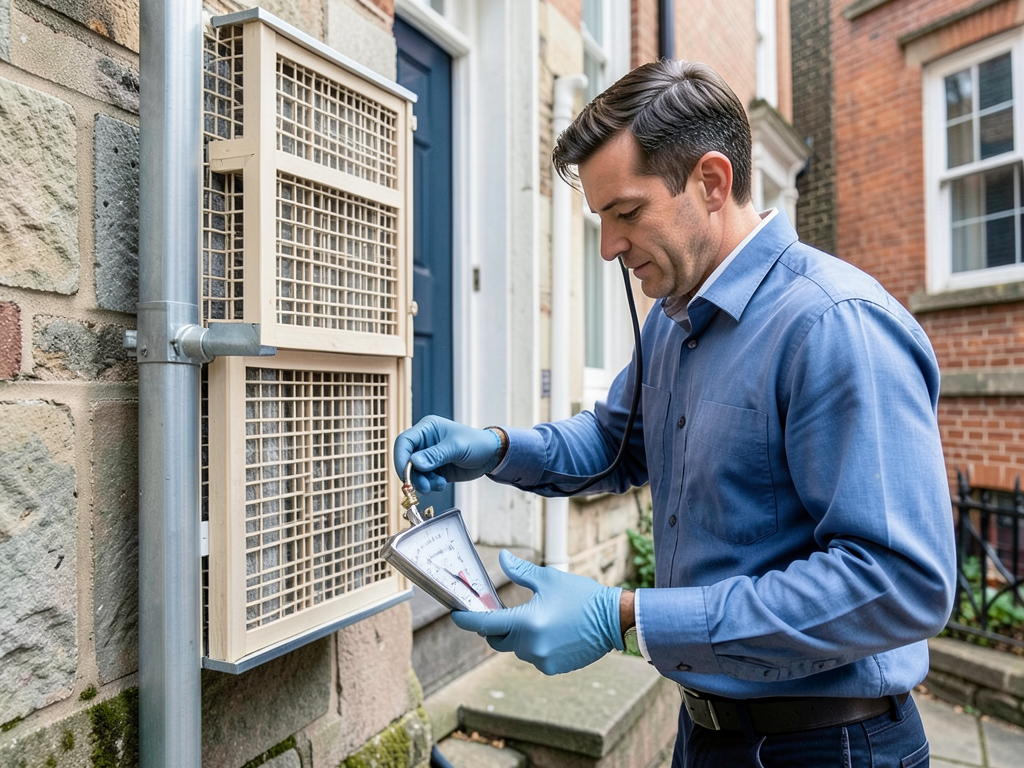
Emergency ac duct repair is not the same as scheduled maintenance. We arrive prepared to diagnose under pressure. Our technicians carry thermal imaging cameras to identify temperature differentials that indicate air leakage. We use manometers to measure static pressure across the system and pinpoint restriction points. If a trunk line has separated at a plenum connection, we see the pressure drop immediately.

We do not guess. We test airflow at each register with a balometer to quantify loss. If you are getting 40 CFM from a register that should deliver 120 CFM, we know the problem is upstream. We trace the duct run and inspect accessible sections with borescope cameras. Most failures occur at transitions where flex duct connects to rigid duct, at takeoff collars, or where ducts pass through unconditioned spaces.

Repairs depend on damage type. Separated joints get resealed with mastic and mechanical fasteners, not tape. Crushed flex duct gets replaced with new R-8 insulated flex, tensioned properly to prevent sagging. Corroded sheet metal sections get cut out and replaced with matching gauge material. We restore proper support with adjustable hangers every four feet on horizontal runs. If your system uses undersized return ducts, we flag that for future correction, but the emergency repair focuses on restoring immediate function.

We verify static pressure returns to manufacturer specs before we leave. You get airflow restoration within hours, not days.

What Happens When You Call for Urgent Duct Repair

Emergency Ductwork Repair in Washington, D.C. – 24/7 Dispatch and Same-Day Arrival
01

Immediate Dispatch and Arrival

You call (771) 218-6322 and speak directly to our dispatch team. We collect details about symptoms, system age, and whether you smell burning or see visible damage. A certified technician is assigned within 10 minutes. You receive a text with technician name, photo, and estimated arrival time. Most D.C. service areas receive arrival within 90 minutes of the initial call, including evenings and weekends.
02

Diagnostic Testing and Damage Assessment

The technician performs a system pressure test using a digital manometer and checks airflow at supply and return registers. Thermal imaging identifies hidden leaks behind drywall or in attic spaces. We inspect all accessible ductwork for disconnections, crushing, corrosion, or insulation failure. You receive a verbal explanation of the problem, the repair required, and the cost before any work begins. No surprises.
03

Repair Execution and Airflow Verification

We complete the repair using professional-grade materials and mechanical fasteners. Separated sections are reconnected and sealed with mastic. Damaged duct is replaced with matching insulation values. We retest static pressure and airflow at registers to confirm restoration to design specifications. You see the data before we leave. Your system is operational, your home is comfortable again, and the emergency is resolved.

Why D.C. Homeowners Trust Patriot HVAC for Duct Emergencies

Washington, D.C. has strict building codes, especially in historic districts like Dupont Circle and Shaw. Ductwork modifications require permits for certain configurations, and improper repairs can fail inspection during home sales. Patriot HVAC Washington DC operates with full knowledge of D.C. residential code requirements and understands when permit-required work is necessary versus emergency stabilization that falls under repair exemptions.

Our technicians have worked inside rowhouses with shared walls, condos with limited attic access, and historic homes where ductwork routes through unusual cavities. We know how to navigate tight crawlspaces in Capitol Hill basements and attics with knob-and-tube wiring still present. We carry equipment sized for urban residential constraints, including compact vacuum pumps and battery-powered shears that work in spaces without outlet access.

D.C.'s housing stock includes everything from 1920s brick colonials to modern LEED-certified construction. Ductwork varies wildly. Older homes often have undersized return ducts and uninsulated sheet metal runs. Newer homes use spray foam encapsulation that hides duct leaks until catastrophic failure. We have repaired ductwork in all of it. We do not treat every home the same because every system is different.

You are not hiring a national franchise with rotating subcontractors. You are hiring a local team that responds from our D.C. facility, not a call center in another state. We answer our phones. We show up when we say we will. We fix the problem correctly the first time because your neighbors are our references.

What You Get When You Choose Emergency Duct Repair from Patriot HVAC

Rapid Response and Same-Day Service

We operate 24 hours a day, 365 days a year. Calls are answered by our dispatch team within three rings, not an automated system. Technicians are dispatched immediately, and you receive an estimated arrival time via text. Most service areas in D.C. receive arrival within 90 minutes. Evening and weekend service carries no surcharge. If your system is down, we treat it as the emergency it is. You do not wait until Monday. You do not suffer through a hot weekend. You get help now.

Transparent Diagnosis with Measurable Data

You receive a full explanation of the problem before we start the repair. We show you thermal images if leaks are present. We measure static pressure and airflow with calibrated instruments. You see the numbers. We explain what caused the failure and what is required to fix it. You receive a written quote for the repair. No work begins until you approve the scope and cost. After the repair, we retest and show you the corrected data. You know the system is fixed because we prove it with measurements.

Professional Repair with Code-Compliant Materials

We do not use duct tape for permanent repairs. Separated joints are resealed with mastic and mechanical fasteners. Damaged flex duct is replaced with R-8 insulated flex that meets D.C. energy code requirements. Sheet metal repairs use matching gauge material and are riveted or screwed, not glued. We install proper duct hangers and support straps to prevent future sagging. The repair is built to last, not just to hold until the next failure. You get professional-grade work that passes inspection.

Follow-Up and System Monitoring

After the emergency repair, we provide a written summary of what was done and recommendations for any additional work that should be scheduled when time permits. If your system has underlying issues like undersized returns or poor insulation, we document those for future correction. We follow up within 48 hours to ensure the repair is holding and your system is performing correctly. If you experience any issues related to the repair, we return at no charge. You also receive information about our maintenance plans, which include annual duct inspections to catch problems before they become emergencies.

Frequently Asked Questions

You Have Questions,
We Have Answers

What qualifies as an HVAC emergency? +

An HVAC emergency is any situation that poses immediate health risks, property damage, or complete system failure. In Washington, D.C., this includes total heating loss during winter freezes, complete air conditioning failure during dangerous summer heat waves, visible flames or burning smells, carbon monoxide detector alerts, major duct collapses blocking airflow, or gas leaks near your system. High humidity and extreme seasonal swings in the District make temperature control critical. If you smell gas, evacuate immediately and call 911. For urgent duct failures causing unsafe indoor air quality or no airflow, contact an emergency HVAC technician right away.

What's the average cost to replace ductwork? +

Complete ductwork replacement costs vary widely based on home size, layout, and accessibility. Factors include duct material (flexible, sheet metal, or fiberboard), the complexity of your home's configuration, and whether you need asbestos abatement in older Washington, D.C. row homes. A full replacement typically involves removing old ducts, sealing gaps, and installing properly sized new runs. Townhomes and historic properties in neighborhoods like Capitol Hill or Dupont Circle often require custom fabrication due to tight spaces and unique architectural features. Get multiple written estimates from licensed contractors. Focus on proper sizing and sealing, not just lowest price.

Is duct work covered by homeowners insurance? +

Homeowners insurance typically covers ductwork damage only if caused by a covered peril like fire, vandalism, or sudden storm damage. Gradual deterioration, poor installation, neglect, or normal wear and tear are excluded. If a tree falls on your Washington, D.C. home during a severe thunderstorm and damages ductwork, your policy may cover repairs. Pest damage, mold from chronic humidity issues, or rust from years of condensation generally are not covered. Review your specific policy and document all damage with photos immediately. Some policies require professional inspections. Contact your insurance agent before starting emergency repairs to understand your coverage limits.

Who checks air ducts for leaks? +

Licensed HVAC technicians check air ducts for leaks using specialized diagnostic tools. They perform pressure tests, thermal imaging scans, and visual inspections to locate gaps, disconnected joints, or damaged sections. In Washington, D.C., where older homes dominate neighborhoods like Georgetown and Shaw, hidden leaks in crawl spaces or attics are common. Technicians use a duct blaster test to measure total system leakage. This pressurizes your ductwork and calculates escaping air. Professional leak detection identifies where conditioned air escapes into unconditioned spaces, driving up energy bills. Do not attempt leak detection yourself. Accurate diagnosis requires calibrated equipment and training.

What is the $5000 rule for HVAC? +

The $5000 rule is an industry guideline that helps homeowners decide between repairing or replacing a failing HVAC system. Multiply the age of your unit by the estimated repair cost. If the total exceeds $5000, replacement often makes better financial sense than repair. For example, if your 12-year-old furnace needs a $500 repair, the calculation is 12 x 500 equals 6000, suggesting replacement. This rule accounts for diminishing returns on aging equipment. In Washington, D.C., where high humidity accelerates wear, older systems lose efficiency faster. Consider energy savings, remaining lifespan, and whether emergency ductwork repairs compound existing system problems.

What qualifies as an emergency repair? +

An emergency repair addresses immediate threats to safety, health, or prevents catastrophic property damage. Examples include gas leaks, carbon monoxide detection, electrical hazards, complete heating failure in freezing weather, or total cooling loss during dangerous heat. In Washington, D.C., where summer temperatures regularly exceed 90 degrees with oppressive humidity, lost air conditioning can create life-threatening conditions for elderly residents or those with respiratory conditions. Major duct collapses that block all airflow or cause sharp metal edges to enter living spaces qualify as emergencies. If the situation can wait 24 hours without risk, it is urgent but not emergency-level.

What is the 2 foot rule for ductwork? +

The 2 foot rule states that ductwork connections should extend at least 2 feet beyond the conditioned space envelope before terminating or transitioning. This prevents conditioned air loss into unconditioned areas like attics or crawl spaces. In Washington, D.C. row homes and older construction, ducts often run through uninsulated zones. Proper extension ensures heated or cooled air reaches intended rooms before potential leaks occur. The rule also applies to flexible duct installations, which must be fully stretched without sagging or kinking for that initial 2 foot span. Violating this guideline wastes energy and reduces system efficiency, especially in the District's extreme seasonal temperature swings.

How much to replace ductwork in a 2000 sq ft house? +

Replacing ductwork in a 2000 square foot house depends on system complexity, home layout, and accessibility. Multi-level homes, finished basements, or older Washington, D.C. row homes with limited crawl space access increase labor costs. Material choice matters: flexible duct costs less than rigid sheet metal but may not suit all applications. Historic properties in neighborhoods like Logan Circle often require custom fabrication to navigate tight spaces and preserve architectural details. Factor in proper insulation, sealing, and code-compliant installation. Get detailed written estimates from multiple licensed contractors. Prioritize proper sizing calculations and quality installation over lowest bid.

Can I replace ductwork myself? +

Do not replace ductwork yourself. Proper duct installation requires load calculations, understanding airflow dynamics, knowledge of local building codes, and specialized tools. Incorrectly sized or poorly sealed ducts waste energy, create pressure imbalances, and damage your HVAC system. Washington, D.C. building codes mandate specific R-values for duct insulation and sealing standards. You risk voiding equipment warranties, failing inspections, and creating safety hazards like backdrafting combustion gases. Ductwork in crawl spaces or attics involves working in confined, dangerous conditions. Licensed HVAC contractors carry insurance and guarantee code-compliant work. Emergency duct failures require immediate professional response to restore safe, efficient operation.

How much does it cost to clean out air ducts in a house? +

Duct cleaning costs vary based on system size, accessibility, contamination level, and whether additional services like mold remediation or sanitizing are needed. Washington, D.C. homes with high humidity often accumulate more dust, pollen, and mold in ductwork. Older row homes in neighborhoods like Shaw or Columbia Heights may have decades of buildup. Reputable companies charge per vent or by linear footage, including supply and return ducts. Avoid bait-and-switch companies advertising extremely low rates. Professional cleaning uses HEPA-filtered vacuums and rotary brushes. If you smell mold, see visible debris, or have unexplained respiratory issues, get written estimates from licensed contractors.

How D.C.'s Humidity and Historic Housing Stock Accelerate Duct Failure

Washington, D.C. averages 66% relative humidity year-round, which creates constant condensation inside ductwork during cooling season. When conditioned air at 55 degrees moves through ducts in 130-degree attics, moisture forms on interior duct surfaces. This condensation corrodes sheet metal, degrades mastic sealant, and promotes mold growth on insulation. Homes in neighborhoods like Shaw and Bloomingdale often have original ductwork from the 1950s, installed before modern insulation standards. These uninsulated or under-insulated ducts fail faster under D.C.'s aggressive humidity. Immediate ductwork service becomes necessary when condensation damage causes rust-through or joint separation.

D.C. enforces strict residential codes, and ductwork modifications in historic districts require permits and inspections. Patriot HVAC Washington DC understands the difference between emergency repairs that restore function and modifications that trigger permit requirements. We work within D.C.'s regulatory framework, ensuring that urgent air duct repair does not create compliance issues during future home sales or inspections. Our technicians are trained on local code nuances, including return air requirements and insulation minimums. Choosing a local provider means you get repairs that meet D.C. standards, not generic fixes that fail inspection.
HVAC Services in The Washington DC Area

Easily locate Patriot HVAC and explore our service area on the map below. We are strategically positioned to provide prompt and efficient heating, ventilation, and air conditioning services across Washington D.C. and its neighboring communities. Whether you're seeking a quick repair or a new installation, our team is ready to serve your comfort needs.

Address:
Patriot HVAC Washington DC, 20 F St NW, Washington, DC, 20001

Additional Services We Offer

Our news updates

Latest Articles & News from The Blogs

A seasonal guide to the best day to switch from cooling to heating in Washington DC Washington DC homeowners face…

A seasonal guide to the best day to switch from cooling to heating in Washington DC

A seasonal guide to the best day to switch from cooling to heating in Washington DC Washington DC homeowners face…

The Ultimate Spring HVAC Checklist for Large Family Homes in Crestwood

The Ultimate Spring HVAC Checklist for Large Family Homes in Crestwood Spring in Washington DC means the humid summer heat…

Keeping construction dust out of your Buzzard Point apartment during nearby building projects

Keeping construction dust out of your Buzzard Point apartment during nearby building projects Construction dust from new developments along the…

Contact Us

Your system will not fix itself. Every hour you wait, you lose conditioned air and strain your equipment. Call (771) 218-6322 now for same-day emergency ductwork repair. We dispatch immediately and restore airflow fast.