Menu

Understanding Ductless Systems in Washington, D.C. – Your Complete Guide to Mini Split Technology and Indoor Comfort

Learn how ductless mini splits work, when they make sense for your home or business, and why Washington, D.C.'s unique climate and historic building stock make ductless HVAC systems a smart solution for year-round comfort.

Slider Image 1
Slider Image 2
Slider Image 3
Slider Image 4
Slider Image 5
Slider Image 7
Slider Image 8
Slider Image 9
Slider Image 10
Slider Image 11

Why Ductless Systems Are Gaining Ground in Washington, D.C.

Washington, D.C. presents unique challenges for traditional forced-air HVAC systems. The city's high summer humidity and variable winter temperatures put constant demands on heating and cooling equipment. Add to that the prevalence of historic rowhouses, Capitol Hill townhomes, and Georgetown brownstones built before central air became standard, and you face a reality where traditional ductwork is impractical or impossible to install.

This is where ductless mini splits earn their place. A ductless air conditioning guide starts with understanding the basics of mini split systems. These systems split the refrigeration cycle into two components: an outdoor compressor and one or more indoor air handlers. Refrigerant lines run between them through a small penetration in the wall, typically three inches in diameter. No ductwork required.

What are ductless heat pumps in the context of Washington, D.C.? They are reversible systems that cool in summer and heat in winter by moving thermal energy rather than generating it. This makes them efficient in the District's climate zone, where temperatures rarely drop below 20 degrees Fahrenheit for extended periods.

The ductless HVAC system explained simply: outdoor unit compresses refrigerant, indoor unit distributes conditioned air directly into the space. Each indoor head operates independently, creating zones you control separately. One unit cools your second-floor bedroom while another handles your ground-floor office.

Understanding how ductless mini splits work means recognizing they solve real problems for D.C. residents. Narrow rowhouses with no attic space. Additions where extending existing ductwork is cost-prohibitive. Historic properties where preservation rules limit modification options. Room-by-room comfort control that reduces energy waste.

Why Ductless Systems Are Gaining Ground in Washington, D.C.
How Ductless Technology Solves Real Comfort Problems

How Ductless Technology Solves Real Comfort Problems

The mechanics behind ductless systems are straightforward but sophisticated. The outdoor condenser houses the compressor, condenser coil, and expansion valve. Refrigerant circulates through insulated copper lines to one or more indoor air handlers mounted on walls or recessed into ceilings. Each indoor unit contains an evaporator coil, a fan, and electronic controls.

During cooling mode, the indoor coil absorbs heat from your space and transfers it outside. The refrigerant changes state from liquid to gas as it absorbs thermal energy, then the compressor pressurizes it back to liquid outdoors where the heat dissipates. In heating mode, the cycle reverses. The outdoor unit extracts heat from outside air, even when temperatures drop into the 30s, and concentrates it indoors.

Inverter-driven compressors modulate capacity to match the load. Instead of cycling on and off like traditional systems, they ramp up or down continuously. This eliminates temperature swings and reduces energy consumption. You set your desired temperature, and the system adjusts compressor speed to maintain it within half a degree.

Multi-zone configurations allow up to eight indoor units on a single outdoor condenser. Each zone operates independently with its own thermostat and schedule. Your northwest-facing living room that bakes in afternoon sun can run cooling while your shaded basement office stays off. This zoned approach cuts energy use by 30 to 40 percent compared to conditioning your entire home to the same temperature.

Installation requires mounting the outdoor unit on a concrete pad or wall brackets, drilling the line set penetration, running refrigerant lines and electrical connections, and securing indoor units. A qualified technician must evacuate air from the lines, pressure test for leaks, and charge the system with the correct refrigerant volume. Improper installation leads to efficiency loss, compressor failure, and refrigerant leaks.

What Happens When You Explore Ductless Options

Understanding Ductless Systems in Washington, D.C. – Your Complete Guide to Mini Split Technology and Indoor Comfort
01

Initial Site Assessment

A technician evaluates your space to determine heating and cooling loads, identify optimal indoor unit locations, and plan refrigerant line routing. This includes measuring room dimensions, assessing insulation quality, noting window exposure, and checking electrical capacity. For historic D.C. properties, we also verify any preservation restrictions that might affect installation. The goal is matching system capacity to actual demand, not oversizing equipment.
02

Equipment Selection and Planning

Based on the assessment, we specify outdoor unit capacity measured in BTUs and recommend indoor unit types for each zone. Wall-mounted units are most common, but ceiling cassettes and floor-mounted options exist for specific applications. We calculate refrigerant line lengths, plan condensate drainage routes, and determine electrical requirements. For multi-zone systems, we balance capacities across zones to optimize efficiency and ensure the outdoor unit can handle peak simultaneous demand.
03

System Commissioning and Training

After physical installation, technicians test all electrical connections, verify refrigerant charge using superheat and subcooling measurements, and run each zone through heating and cooling cycles. We program thermostats or wireless controllers, demonstrate operation to you, and explain maintenance requirements like filter cleaning schedules. Proper commissioning ensures the system operates at rated efficiency from day one. You receive documentation including equipment model numbers, refrigerant type, and recommended service intervals.

Why Local Expertise Matters for Ductless Systems in the District

Washington, D.C. operates under specific building codes and historic preservation regulations that affect HVAC installations. Capitol Hill Historic District, Georgetown, and other designated areas require approval for exterior modifications. Mounting an outdoor condenser on a street-facing wall may need Historic Preservation Review Board clearance. We navigate these requirements regularly and know which mounting approaches pass review.

The District's climate sits in ASHRAE Zone 4A, characterized by hot, humid summers and cold winters. This mixed-humid classification means ductless heat pumps must handle both significant cooling loads and provide adequate heating capacity when temperatures drop. We size equipment using Manual J load calculations specific to D.C.'s weather data, accounting for the urban heat island effect that raises temperatures 5 to 7 degrees compared to surrounding suburbs.

Electrical service in older D.C. rowhouses often runs 100 or 150 amps. Adding ductless systems requires verifying available capacity and sometimes upgrading panels. We coordinate with licensed electricians familiar with D.C. electrical codes and permitting processes. Refrigerant line routing through century-old masonry walls demands different techniques than wood-frame construction. We use core drilling equipment that minimizes vibration and structural impact.

Local building codes require refrigerant circuit isolation valves, proper condensate drainage with secondary overflow protection, and specific clearances around outdoor units. We pull permits when required and schedule inspections to ensure code compliance. This protects you from future issues when selling your property or filing insurance claims.

Patriot HVAC Washington DC maintains relationships with equipment distributors who stock parts for the brands we install. When a component fails, we source replacements quickly rather than waiting days for shipping. Our technicians train on the specific equipment we sell, not general overviews. This means faster diagnosis and accurate repairs.

What to Expect from a Ductless System Installation

Installation Timeline and Process

Single-zone installations typically complete in one day. Multi-zone systems with three to five indoor units take one to two days depending on refrigerant line routing complexity and electrical work required. The process includes mounting outdoor and indoor units, drilling wall penetrations, running and insulating refrigerant lines, pulling electrical circuits, connecting condensate drains, pressure testing, evacuating air from lines, charging refrigerant, and testing all functions. We protect your floors and furniture during work and remove all debris when finished. Scheduling depends on equipment availability and permit approval timelines.

System Design and Load Calculations

Proper sizing starts with room-by-room load calculations following ACCA Manual J methodology. We measure ceiling heights, calculate window areas and orientations, assess insulation values, and account for occupancy and equipment heat gains. Oversized equipment short-cycles and fails to dehumidify properly. Undersized systems run constantly and never reach set temperature. We match indoor unit capacity to each room's specific load. For multi-zone systems, we verify the outdoor unit capacity covers peak simultaneous demand across all zones, typically 70 to 80 percent of total indoor capacity.

Performance and Efficiency Results

Ductless mini splits achieve SEER ratings between 18 and 30, compared to 14 to 16 for standard central systems. Higher SEER means lower operating costs. Inverter compressors eliminate the startup surge that accounts for 40 percent of energy use in traditional systems. Zoned operation prevents conditioning unused spaces. Expect cooling costs 25 to 40 percent lower than window units or central air. Heating efficiency measured by HSPF typically ranges from 9 to 13, delivering two to three times more heat energy than the electrical energy consumed. This makes heat pumps cost-effective in D.C.'s climate.

Maintenance Requirements and Longevity

Indoor units require monthly filter cleaning during peak use seasons. Remove the front panel, pull out the mesh filters, vacuum or rinse them, and reinstall when dry. Annual professional maintenance includes cleaning indoor coils, checking refrigerant charge, testing electrical connections, cleaning condensate drains, and inspecting outdoor coil fins. Outdoor units need clear airflow, so keep vegetation trimmed back 24 inches and remove leaves or debris that accumulate around the unit. Properly maintained ductless systems last 15 to 20 years. Compressor failure is rare when refrigerant charge stays correct and electrical supply remains stable.

Frequently Asked Questions

You Have Questions,
We Have Answers

How D.C.'s Historic Architecture Makes Ductless Systems Essential

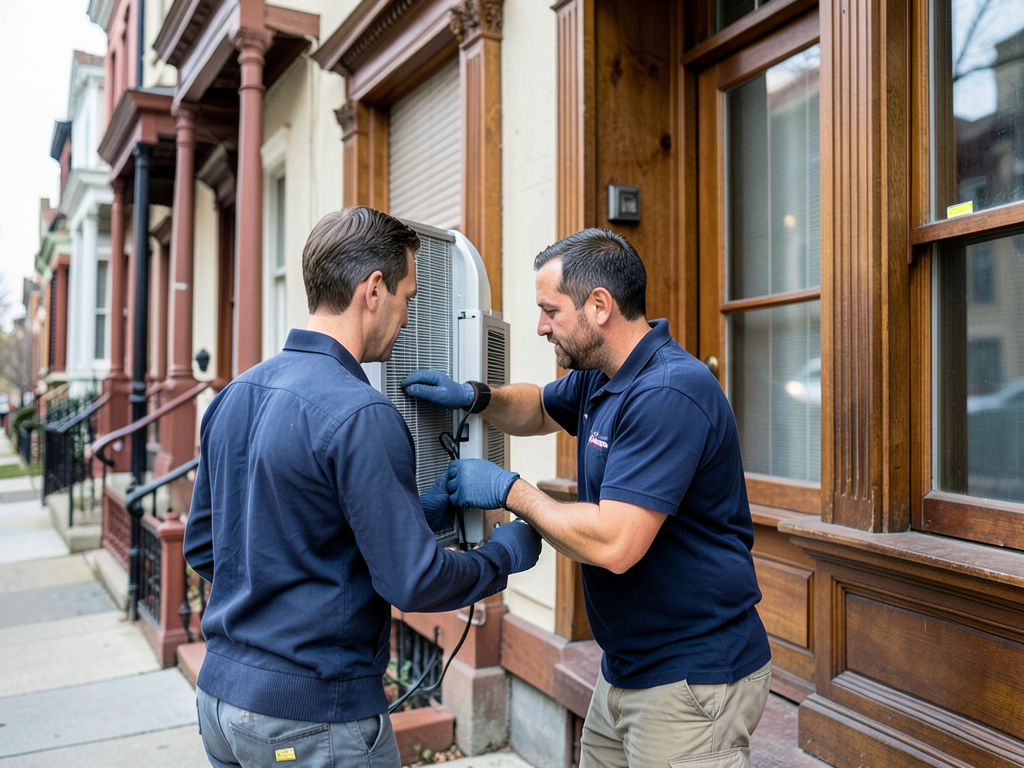
Washington, D.C.'s housing stock includes thousands of rowhouses and townhomes built between 1870 and 1940. These structures feature solid masonry walls, high ceilings, and minimal attic space. Installing traditional ductwork requires building soffits that reduce ceiling height, cutting through load-bearing walls, or sacrificing closet space. Many of these properties sit in historic districts where exterior modifications face strict review. Ductless systems solve these constraints by requiring only a three-inch wall penetration for refrigerant lines. Indoor units mount high on walls where they distribute air effectively without consuming floor space. For Capitol Hill residents dealing with July heat and January cold in homes never designed for central HVAC, ductless technology provides the only practical path to whole-home comfort without compromising historic character.

The District of Columbia requires HVAC contractors to hold both a Master HVAC license and a Basic Business License. Refrigerant handling requires EPA Section 608 certification. Building permits are mandatory for new HVAC installations in most cases. Working in historic districts adds another layer of review through the Historic Preservation Office. Patriot HVAC Washington DC holds all required licenses and maintains current EPA certifications. We file permit applications, coordinate inspections, and document installations to meet District requirements. This regulatory knowledge protects your investment and ensures your system meets all legal standards. Choosing a properly licensed contractor also matters for insurance purposes. Many homeowner policies require licensed contractors for claims related to equipment failure or installation defects.
HVAC Services in The Washington DC Area

Easily locate Patriot HVAC and explore our service area on the map below. We are strategically positioned to provide prompt and efficient heating, ventilation, and air conditioning services across Washington D.C. and its neighboring communities. Whether you're seeking a quick repair or a new installation, our team is ready to serve your comfort needs.

Address:
Patriot HVAC Washington DC, 20 F St NW, Washington, DC, 20001

Additional Services We Offer

Our news updates

Latest Articles & News from The Blogs

Meeting Friendship Heights Noise Rules with the Quietest New AC Units on the Market Friendship Heights homeowners know the struggle.…

Meeting Friendship Heights Noise Rules with the Quietest New AC Units on the Market

Meeting Friendship Heights Noise Rules with the Quietest New AC Units on the Market Friendship Heights homeowners know the struggle.…

Finding the right HVAC contractor for your LeDroit Park historic renovation

Finding the right HVAC contractor for your LeDroit Park historic renovation \n\n LeDroit Park’s Victorian rowhouses built in the 1870s…

How a Whole-House Dehumidifier Can Make Your Marshall Heights Home Feel 10 Degrees Cooler

How a Whole-House Dehumidifier Can Make Your Marshall Heights Home Feel 10 Degrees Cooler Washington DC's swampy summers make your…

Contact Us

Call (771) 218-6322 to schedule a no-obligation assessment. We will evaluate your property, explain your options, and provide a detailed proposal. Our technicians answer your questions in plain language and help you make an informed decision about ductless technology.